
Witchboard Review: Jamie Campbell Bower Steals the Show in a Playfully Lurid Occult Thriller
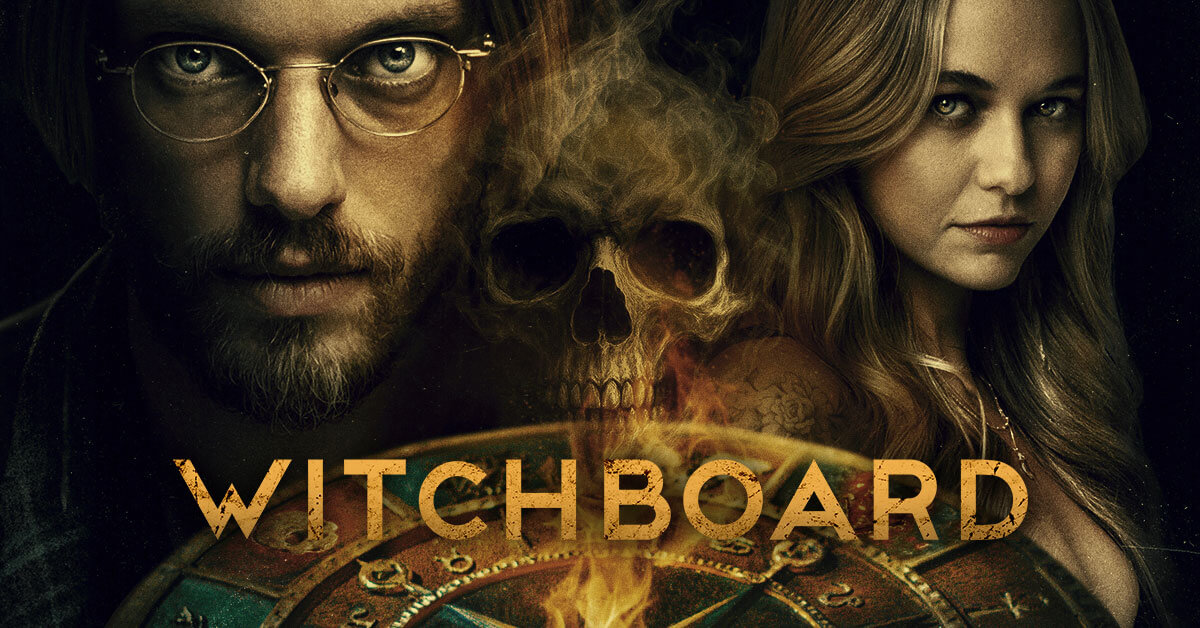
There is a particular kind of pleasure to be found in horror films that know exactly what they are—and Witchboard, director Chuck Russell’s glossy remake of the 1986 cult oddity, mostly falls into that category. It is lurid, knowingly tacky, intermittently ridiculous, and occasionally inspired. More importantly, it is buoyed by a gloriously scene-stealing performance from Jamie Campbell Bower, who appears to have quietly carved out a niche as modern horror’s most elegant purveyor of menace.
Bower, best known to mainstream audiences as Vecna in Stranger Things, once again proves that his greatest strength lies not in brute intimidation but in presentation. He slinks through Witchboard like a decadent specter, delivering ominous pronouncements in a cultivated accent, dipping his chin and peering upward with unnervingly pale blue eyes. When he enters a scene, the film snaps into focus. When he leaves, it often slumps back into B-movie inertia.
Still, Witchboard is not without its charms. For viewers willing to embrace its camp instincts and forgive its narrative clumsiness, it offers a lively, if uneven, occult thriller that flirts shamelessly with genre excess while never entirely surrendering to it.
A Familiar Curse, Recast
At its core, Witchboard adheres closely to the structural bones of its predecessor: a mystical board, somewhere between a Ouija and a divining tool, becomes the conduit for a malevolent spirit, with predictably disastrous consequences. The twist here lies in the specificity of the haunting. Rather than a generic demon or anonymous ghost, the entity summoned is a 17th-century French witch, whose identity and grievances bleed into the lives of the modern characters unfortunate enough to make contact.
The setting has been relocated to New Orleans, a city whose cinematic associations with mysticism, colonial history and occult lore do much of the atmospheric heavy lifting. It is an inspired choice, even if the film occasionally leans too hard on its own aesthetic shorthand—moss-draped trees, candlelit interiors, whispered invocations—to fully capitalize on the city’s layered cultural complexity.
The Plot: Mushrooms, Memories and Malefic Forces
The story follows Emily (Madison Iseman), an earnest young woman navigating adulthood alongside her boyfriend Christian (Aaron Dominguez), a hipster chef on the cusp of opening a restaurant. Their dynamic is initially sketched with the kind of breezy, millennial realism that modern horror often uses as a grounding device: mushroom foraging, culinary ambition, soft domestic banter.
That equilibrium is disrupted when Emily stumbles across the titular witchboard in the forest. At the urging of Christian’s sultry ex-girlfriend Brooke (Mel Jarnson), Emily experiments with the board, unwittingly opening a channel to the spirit of the long-dead witch.
Soon, Emily begins experiencing vivid flashbacks—memories of a life she has never lived, rendered in French-accented whispers and period imagery. These visions suggest a psychic overlap between Emily and the witch, raising questions about reincarnation, possession and inherited trauma.
It is a compelling setup, even if the film struggles to explore its implications with much depth.
Jamie Campbell Bower: The Film’s Beating, Blackened Heart
Enter Alexander Baptiste, played with relish by Jamie Campbell Bower. An antiquities expert with a suspiciously intimate knowledge of the occult, Alexander is introduced literally in the shadows—a classic genre move that Bower exploits to maximum effect.
He is part scholar, part charlatan, part devil’s advocate. His performance is layered with theatrical restraint: every pause feels deliberate, every smile just a fraction too knowing. He understands that horror villains are often most effective when they invite fascination rather than revulsion.
Bower’s Alexander evokes comparisons to Peter Cushing, the great Hammer Horror stalwart, though filtered through a modern, fashion-forward sensibility. There is also something of the young Ralph Fiennes in his “rent-a-villain” phase—an actor clearly enjoying the seductive possibilities of controlled malevolence.
If Witchboard works at all as a serious piece of entertainment, it is largely because of him.
When the Spell Weakens
Unfortunately, the film cannot sustain Bower’s level of engagement throughout. When Alexander exits the frame, Witchboard often collapses into familiar genre pitfalls.
The supporting cast, while competent, is uneven. Iseman does her best with a role that requires more reaction than action, oscillating between confusion, fear and haunted detachment. Dominguez’s Christian is amiable but underwritten, while Jarnson’s Brooke leans heavily into archetype—provocative, manipulative, narratively convenient.
Dialogue frequently slips into exposition-heavy exchanges, and character decisions are often dictated by plot necessity rather than believable motivation.
French Flashbacks and Culinary Credibility
One of the film’s more inspired touches is its commitment to French-language flashbacks, which lend an unexpected air of authenticity to the witch’s story. These sequences, though brief, are among the film’s most evocative, hinting at persecution, betrayal and historical injustice without spelling everything out.
Similarly, the scenes set in Christian’s restaurant kitchen feel surprisingly grounded. The choreography of prep work, the stress of impending opening night, and the camaraderie among staff suggest that someone behind the scenes did their homework—or at least binged enough The Bear to get the rhythm right.
These moments of realism help anchor the film, even as its supernatural elements spiral into increasingly absurd territory.
A Cat, a Dealer and a Glorious Descent Into Camp
Then there is the maine coon incident.
In one of Witchboard’s most notorious sequences, a seemingly ordinary cat attacks a drug dealer before transforming into a blur of digital effects and rubbery menace. The scene is objectively ridiculous—poorly rendered, tonally jarring and utterly implausible.
And yet, it is also strangely delightful.
This is the moment where Witchboard fully embraces its B-movie heritage. The cat attack is so gloriously excessive, so unconcerned with restraint, that it almost redeems the film’s weaker stretches by sheer force of audacity.
It is the kind of scene that midnight-movie audiences will either howl at or quote endlessly.
Chuck Russell’s Balancing Act
Director Chuck Russell, best known for A Nightmare on Elm Street 3: Dream Warriors and The Mask, has always excelled at walking the line between horror and spectacle. Here, he attempts a similar balancing act—modernizing a cult property without sanding down its rough edges.
At times, he succeeds. The pacing is brisk, the visual language clear, and the film rarely overstays its welcome. At other moments, the tonal shifts feel abrupt, as though Witchboard is unsure whether it wants to be taken seriously or enjoyed ironically.
In the end, it tries to be both—and that may be its greatest weakness and its most endearing trait.
Themes Beneath the Surface
Beneath the schlock and spectacle, Witchboard gestures toward deeper themes: the persistence of historical trauma, the exploitation of women labeled as dangerous or deviant, and the seductive pull of forbidden knowledge.
However, these ideas remain largely underdeveloped. The film introduces them, flirts with their implications, then retreats back into jump scares and narrative convenience. One senses a richer story struggling to emerge beneath the surface.
A Film That Knows Its Audience
Ultimately, Witchboard understands who it is for. This is not elevated horror in the vein of Hereditary or The Witch. Nor does it aspire to the operatic excess of prestige genre filmmaking.
Instead, it occupies a middle ground: knowingly trashy, intermittently clever, and buoyed by a performance that elevates the material beyond its limitations.
For fans of occult thrillers, cult horror remakes and charismatic villains, it offers enough pleasures to justify the ride.
Final Verdict
Witchboard is a film of contradictions—cheap yet entertaining, clumsy yet occasionally inspired. Its narrative falters, its effects wobble, and its secondary characters blur together. But whenever Jamie Campbell Bower is on screen, the film crackles with life.
If he continues selecting roles like this, he may well become the defining horror icon of his generation—not by reinventing the genre, but by mastering its oldest tricks.
And sometimes, that’s more than enough.
Witchboard is available on digital platforms from 2 February.