
MLWBD: Dreamers Review — Love, Resistance and the Quiet Power of Human Dignity
In an era marked by escalating hostility toward migrants and refugees, Dreamers arrives not only as a timely intervention but as a quietly radical act of empathy. Directed by Joy Gharoro-Akpojotor in her assured feature debut, the film interrogates the cruelty and contradictions of the UK’s immigration detention system while simultaneously offering something rarer: a tender, sensuous queer love story that insists on joy and selfhood even within the most dehumanising of circumstances. That Dreamers succeeds on both fronts—political critique and intimate romance—is a testament to the clarity of Gharoro-Akpojotor’s vision and the emotional intelligence underpinning every creative choice.
At just 78 minutes, Dreamers wastes no time in situating us inside its oppressive world. We meet Isio (Ronkẹ Adékoluẹjo), an undocumented Nigerian-born migrant, at the moment she is delivered to Hatchworth Removal Centre. The name itself is a grim irony. Hatchworth is not a place of new beginnings but a bureaucratic holding pen, where lives are suspended indefinitely and hope is rationed in small, unreliable doses. Upon arrival, Isio is greeted by guards who blandly assure detainees that they are “here to help.” The film never editorialises this lie; it simply lets the daily reality of the centre expose it for what it is.
Gharoro-Akpojotor, drawing in part from her own experience seeking asylum in the UK at the age of 25, approaches this space with an unflinching but deeply humane eye. There is no sensationalism here, no attempt to heighten cruelty for dramatic effect. Instead, the film observes how institutional indifference grinds people down through routine humiliations: the lack of privacy, the arbitrary rules, the constant uncertainty surrounding asylum pleas. Dreamers understands that the most damaging violence of such systems is often slow, procedural and relentlessly impersonal.
Yet from the outset, the film resists framing Isio solely as a victim. Adékoluẹjo’s performance is grounded, interior and quietly defiant. Isio arrives guarded, emotionally armoured, her body language closed off as a matter of survival. She has learned, through bitter experience, that openness can be dangerous. In Nigeria, where homosexuality is criminalised, being herself carried the risk of imprisonment or worse. That history hangs over her, shaping every interaction, even as the film initially withholds the specifics of her past.
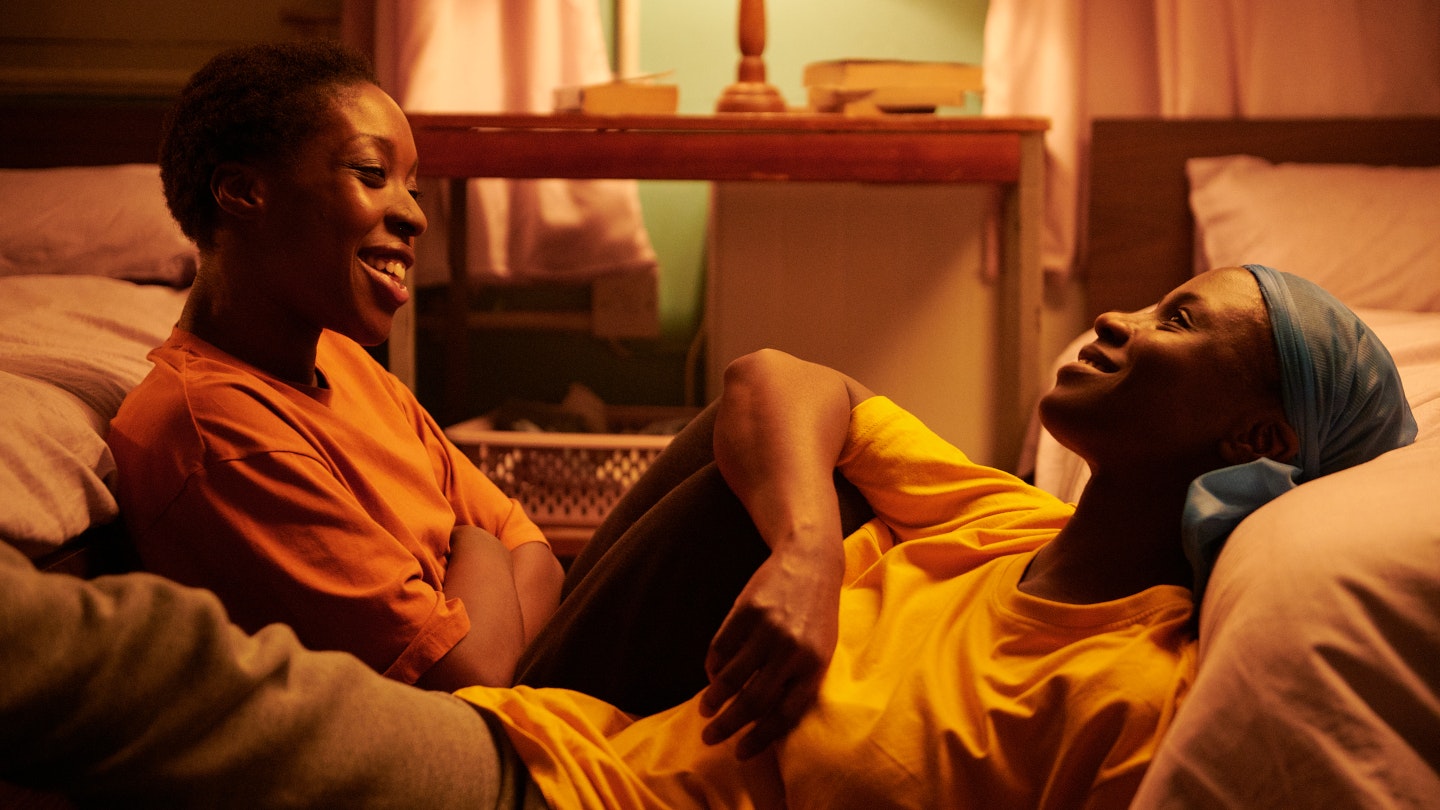
Inside Hatchworth, Isio is assigned a roommate, Farah, played with luminous warmth by Ann Akinjirin. Farah is, at first glance, Isio’s opposite: more open, more emotionally expressive, someone who has not entirely lost her capacity for connection. Their friendship develops tentatively, built on small gestures and shared routines rather than instant intimacy. Gharoro-Akpojotor is patient in charting this bond, allowing it to unfold organically against the claustrophobic backdrop of detention life.
As Isio reluctantly begins to form connections, Dreamers widens its lens to include a small but vividly sketched community of detainees. Nana (Diana Yekinni) and Atefeh (Aiysha Hart) emerge as crucial figures, each bringing their own histories, anxieties and coping mechanisms into the shared space. Though their screen time is limited, both actors imbue their roles with specificity, reminding us that no two immigrant stories are the same, even when the system treats them as interchangeable cases.
This emphasis on community is one of the film’s quiet strengths. Gharoro-Akpojotor avoids the trap of portraying detention solely as a site of isolation. Instead, she shows how solidarity can form in the most unlikely of places, how shared precarity can foster bonds that are at once fragile and fiercely sustaining. Laughter, gossip and moments of mutual care puncture the bleakness, not as denial, but as acts of resistance.
Still, Dreamers is not content to be read simply as a social-issues film. While its critique of the asylum system is sharp and unsparing, the film’s emotional core lies elsewhere: in its insistence on the right to live freely, to love openly, even when circumstances conspire to make such freedoms seem impossible. It is this philosophy that fuels the evolving relationship between Isio and Farah, transforming the film into something far more intimate and, ultimately, more subversive.
When we learn that Isio fled Nigeria because she is a lesbian, the revelation feels less like a plot twist than a clarification of what has already been suggested through her guarded demeanour. Her queerness is not framed as a defining “issue” but as an intrinsic part of who she is—one that has shaped her journey and sharpened the stakes of her asylum plea. In contrast to the punitive environment she has escaped, the growing intimacy with Farah offers a glimpse of a life lived on her own terms.
Adékoluẹjo and Akinjirin chart the transition from friendship to romantic connection with remarkable sensitivity. There is no rush toward consummation, no manufactured drama to accelerate the arc. Instead, their chemistry builds through shared silences, stolen looks and moments of vulnerability exchanged in whispered conversations. When their relationship deepens and becomes physical, the film treats these scenes with a rare blend of sensuality and restraint. They are tender, earned and profoundly human, refusing both voyeurism and coyness.
What makes these moments especially powerful is their context. This is love unfolding under constant surveillance, within an institution designed to strip individuals of privacy and autonomy. The very act of desire becomes a form of defiance. Dreamers understands this intuitively, framing intimacy not as an escape from reality but as a means of reclaiming agency within it.
Formally, the film demonstrates an impressive level of craft, particularly given its modest budget. The use of colour is among its most striking elements. At the outset, Isio’s wardrobe is dominated by dark, muted tones that mirror her emotional withdrawal. As she begins to open herself up to friendship and love, subtle shifts occur. Warmer hues gradually enter the frame, reflecting an internal transformation that the film never spells out explicitly.
Colour is also used evocatively in Isio’s flashback sequences, which are punctuated by saturated reds. These moments, brief but potent, hint at the intensity and danger of her past without resorting to explicit depiction. Gharoro-Akpojotor trusts the audience to read emotional cues through visual language, a confidence that pays dividends throughout the film.
The production design further reinforces the film’s themes. Hatchworth Removal Centre is depicted with stark realism: institutional whites and greys, harsh lighting, functional spaces devoid of warmth. Yet within these confines, the camera often finds moments of softness—a shaft of light, a shared glance—that suggest the persistence of humanity even in hostile environments. The film’s visual economy becomes a strength rather than a limitation, proving that invention often flourishes under constraint.
Sound design and score are employed sparingly but effectively. Silence is allowed to linger, particularly in moments of waiting, underscoring the psychological toll of prolonged uncertainty. When music does surface, it tends to heighten intimacy rather than manipulate emotion, aligning us closely with Isio’s internal state.
One of Dreamers’ most commendable qualities is its refusal to offer easy resolutions. The asylum process remains opaque and arbitrary, its outcomes shaped by forces far beyond the control of those ensnared within it. Gharoro-Akpojotor does not promise justice where none is guaranteed, nor does she indulge in false uplift. Instead, the film locates its hope in smaller, more fragile victories: the courage to be seen, the willingness to love, the formation of bonds that affirm one’s existence.
This restraint is particularly notable in a cinematic landscape where stories about migration are often burdened with the expectation of either tragedy or triumph. Dreamers occupies a more complex emotional register, acknowledging pain without fetishising it, and joy without overstating its permanence. The result is a film that feels honest rather than instructive, personal rather than programmatic.
That personal quality is undoubtedly shaped by Gharoro-Akpojotor’s own history. Her background as a producer on projects such as Blue Story and Boxing Day is evident in her confident handling of performance and tone, but Dreamers marks her arrival as a director with a distinct voice. There is a palpable sense that this story matters deeply to her, not as an abstract issue but as lived experience refracted through fiction.
Adékoluẹjo, in particular, delivers a breakout performance. Her portrayal of Isio is rich in interiority, relying less on dialogue than on subtle shifts in posture, expression and gaze. We feel Isio’s fear, her guarded hope, her tentative steps toward trust. Akinjirin matches her beat for beat, bringing humour, vulnerability and quiet strength to Farah. Together, they anchor the film with performances that feel fully inhabited rather than performed.
By the time Dreamers reaches its conclusion, its emotional impact far exceeds its running time. The film lingers not because of narrative twists or dramatic revelations, but because of the humanity it affords its characters. It asks us to see migrants not as statistics or political abstractions, but as complex individuals with desires, fears and dreams that persist even under the harshest conditions.
MLWBD: Dreamers Review ultimately positions Joy Gharoro-Akpojotor as a filmmaker of remarkable sensitivity and purpose. Bold yet tender, politically urgent yet deeply intimate, Dreamers is a debut that announces a major new voice in British cinema. It reminds us that even in systems designed to erase individuality, love can take root—and that sometimes, simply insisting on one’s right to feel, to desire, and to dream is the most radical act of all.