
Mercy Review: A Futuristic Courtroom Thriller Struggling Under Its Own Ambitions
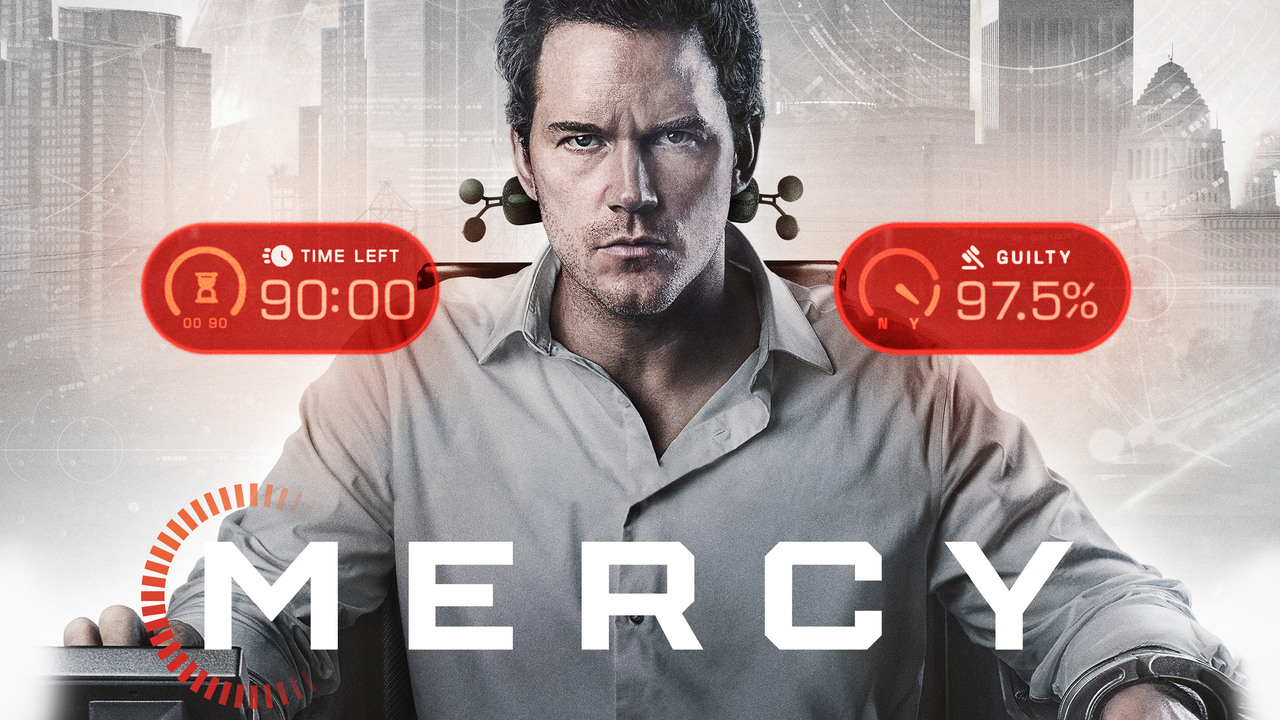
In an era where artificial intelligence is transforming the way we live, work, and even govern, it is unsurprising that Hollywood has sought to interrogate these changes through cinema. Timur Bekmambetov’s latest feature, Mercy, arrives with precisely such ambitions. Released to a landscape already crowded with high-concept sci-fi thrillers—some critically lauded, others dismissed as derivative—it promises a chilling, high-stakes scenario: a man put on trial by an AI judge, facing possible execution unless he can prove his innocence. Yet, while Mercy has the hallmarks of a gripping techno-thriller, the film struggles to balance its conceptual promise with the execution on-screen, leaving audiences with an experience that is often more frustrating than satisfying.
Plot Synopsis: A Race Against the Machine
The narrative premise of Mercy is simple enough but undeniably cinematic. LAPD detective Chris Raven (Chris Pratt) awakens to find himself in the AI-controlled ‘Mercy’ courtroom, where a lifeless yet imposing artificial intelligence judge, Maddox (Rebecca Ferguson), presides over his trial. Accused of murdering his wife, Raven has 90 minutes to prove his innocence before the court reaches its verdict—potentially condemning him to death.
Bekmambetov, who has long been fascinated with blending high-concept action with morally complex scenarios (as seen in Wanted and Abraham Lincoln: Vampire Hunter), attempts to fuse real-time procedural suspense with social commentary. Raven’s journey is told largely in a confined setting, with the bulk of the narrative tension arising from his phone-based attempts to uncover evidence, confront inconsistencies, and navigate the opaque bureaucracy of a society where AI surveillance reigns supreme.
The scenario, as described, evokes echoes of Minority Report’s pre-crime speculation, but stripped of its intellectual heft. The comparison is inevitable, given the film’s focus on predictive justice, a surveillance state, and questions of personal agency. Unfortunately, while Minority Report manages to marry philosophical inquiry with kinetic thrills, Mercy struggles to sustain either fully.
Acting and Characterization: Pratt vs. Ferguson
Chris Pratt’s casting as Chris Raven is, on paper, inspired—his everyman charm and action-star credentials suggest he could carry the film’s tension with ease. In practice, however, the screenplay often constrains him, reducing a potentially complex protagonist to a man strapped to a chair, expositing, panicking, and pleading for his life. Pratt’s performance oscillates between the desperation of a man on the brink and the familiar comedic timing audiences know him for, a tonal dissonance that the film never quite resolves. There are fleeting moments where he manages to convey genuine vulnerability and moral frustration, but they are often swallowed by the procedural nature of the film’s setup.
Rebecca Ferguson, on the other hand, is a consistent bright spot. As Maddox, she embodies an AI judge with a carefully modulated blend of severity and occasional empathy, avoiding caricature while providing a credible counterpoint to Raven’s desperation. Ferguson’s measured delivery imbues the courtroom scenes with a procedural authenticity that the rest of the film sometimes lacks, making her the most compelling reason to watch Mercy. Her performance reminds audiences of the subtle yet crucial human touch that even the most sophisticated AI fails to replicate—a thematic point the film hints at but fails to explore fully.
Annabelle Wallis, cast as Raven’s late wife, occupies a frustratingly underwritten role. Like many female characters in action-centric thrillers, she exists largely as a narrative device—her murder catalyzes the plot, but she is never afforded meaningful agency or backstory. It’s a disservice both to Wallis and to the audience, leaving her performance feeling underused and repetitive.
World-Building and Thematic Concerns
Perhaps the most ambitious aspect of Mercy is its world-building. Bekmambetov attempts to create a near-future society dominated by AI surveillance, extreme social inequality, and heavy-handed policing. The film hints at dystopian “red zones,” areas supposedly rife with lawlessness and crime, juxtaposed with sleek hotels and polished urban landscapes. This contradiction is emblematic of the film’s broader struggles: it gestures toward social critique, yet never fully interrogates the implications of a society willing to offload justice to the cloud.
The film’s thematic ambitions are notable: it touches on pressing issues like systemic injustice, the dehumanizing potential of surveillance technologies, and the dangers of governments prioritizing “tough on crime” optics over nuanced policy. Yet these themes remain underdeveloped. By conflating inequality, homelessness, and criminality without offering critical insight, the film risks superficiality, creating a world that feels more like a set-piece for action sequences than a believable socio-political landscape.
Narrative and Pacing: Tension vs. Throttle
In a procedural thriller, pacing is paramount. Mercy benefits from a structure that theoretically maintains suspense: a ticking clock, real-time phone interactions, and a protagonist racing against the system to prove his innocence. However, while the setup is effective, the payoff is uneven. Small bursts of tension punctuate long stretches of dialogue-heavy exposition, and the film’s commitment to its “AI court procedural” conceit often undermines opportunities for kinetic thrills.
The real-time phone-based investigation is a clever narrative device but becomes repetitive, and the stakes—though conceptually high—rarely feel immediate. Action sequences are sparse and reserved mostly for the final act, leaving the audience in a liminal space of moderate suspense but unfulfilled adrenaline. Bekmambetov’s experience with visual spectacle is evident, yet Mercy’s restrained physicality, combined with underdeveloped environmental threats, limits the film’s capacity to create the full edge-of-your-seat tension that modern audiences expect from the genre.
Sci-Fi Premise: Potential vs. Execution
At its core, Mercy is a meditation on AI, surveillance, and the mechanization of justice. The concept—an AI judge presiding over life-and-death decisions—is undeniably compelling and timely. With society increasingly reliant on algorithms for decision-making, predictive policing, and risk assessment, the ethical dilemmas posed are enormous. How much trust should we place in artificial systems? Can AI truly understand human nuance and moral ambiguity? Bekmambetov gestures toward these questions but never allows them to dominate the narrative.
Instead, the film prioritizes the procedural chase for exculpatory evidence, treating the high-concept ethical questions as secondary, almost decorative. The result is a film that feels thematically ambitious but narratively timid: it raises questions but rarely challenges the audience to wrestle with uncomfortable answers.
Supporting Cast and Performances
While Pratt and Ferguson anchor the film, supporting performances are uneven. Characters are often sketched rather than fully realized, leaving the audience with little emotional investment outside the central courtroom drama. This is particularly evident in secondary roles, which serve primarily to provide exposition or highlight Raven’s ingenuity. In a story about social inequality and surveillance, these peripheral characters could have been used to enrich the world, yet they remain functional rather than fully fleshed out.
This lack of depth extends to the depiction of the AI system itself. Maddox, despite Ferguson’s excellent performance, remains an enigma: the AI’s motivations, programming logic, and ethical parameters are hinted at but never fully articulated, reducing it to a narrative obstacle rather than a complex entity worthy of reflection.
Cinematography, Score, and Technical Execution
On a technical level, Mercy is competent. The cinematography emphasizes confinement and claustrophobia during courtroom sequences, juxtaposed against digitally enhanced cityscapes and surveillance imagery that underscore the dystopian premise. The score, while not particularly memorable, supports the tension in key sequences and subtly reinforces the film’s darker themes. Sound design is effective, particularly in scenes where Raven’s isolation is amplified by the sterile, digital courtroom environment.
However, for a film that relies so heavily on conceptual intrigue, visual storytelling often feels underutilized. Moments that could have been cinematic high points—showing the AI’s surveillance network, the broader societal impact of algorithmic justice—are instead described in exposition, limiting the film’s ability to immerse viewers fully in its world.
Critical and Audience Reception
Early reactions to Mercy have been mixed, reflecting the film’s tension between concept and execution. Critics have praised Ferguson’s performance and the ambitious premise but criticized the uneven pacing, underdeveloped social commentary, and Pratt’s constrained role. Audience reactions mirror this ambivalence: many viewers appreciate the novelty of a real-time AI trial thriller, while others leave feeling the film fails to fully explore its ideas or deliver consistent suspense.
There is a sense that Mercy aspires to the philosophical provocations of RoboCop or the procedural ingenuity of Minority Report, yet it lands somewhere in between, offering intermittent thrills but never achieving the full resonance of its inspirations.
Conclusion: Ambition Outweighs Execution
Mercy is a film of high conceptual ambition hampered by a narrative that plays it too safe. Bekmambetov’s fascination with AI and societal control is evident, yet the story’s structure, pacing, and character development prevent the film from reaching its full potential. Chris Pratt’s everyman heroics are admirable but limited by the script, while Rebecca Ferguson shines as a rare humanizing—or perhaps “AI-humanizing”—force in the narrative.
For viewers seeking a philosophical exploration of AI justice or a high-octane thriller, Mercy will likely feel insufficient. It teases ideas of ethical complexity, social critique, and technological omnipotence but ultimately retreats to a procedural format that prioritizes exposition over engagement. The film is watchable, occasionally thought-provoking, and technically competent, but it never quite achieves the cinematic thrill or intellectual provocation it promises.
In a cinematic landscape increasingly preoccupied with AI, automation, and moral responsibility, Mercy stands as a reminder that intriguing concepts alone cannot carry a film: narrative execution, character depth, and thematic courage remain essential. Bekmambetov has delivered a film with flashes of intelligence and a standout central performance, yet one that ultimately feels like autopilot—well-intentioned, partially effective, but frustratingly limited in scope.
Verdict: Ambitious premise, competent performances, but uneven execution leaves Mercy trapped between philosophical aspiration and procedural thriller. Ferguson alone provides a compelling reason to stay engaged; Pratt’s heroics, while earnest, cannot fully compensate for the film’s structural and thematic gaps.
Rating: ★★½ / 5
Recommended for: Viewers interested in AI ethics, procedural thrillers, and Rebecca Ferguson fans.