
It Feeds Review: A Familiar but Efficient Supernatural Chiller That Knows How to Bite
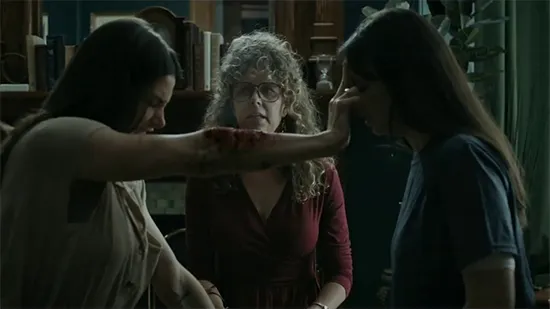
There are few things horror cinema returns to as reliably as the unseen predator. Sometimes it swims beneath the surface, all teeth and instinct, and sometimes it lurks in the shadows, whispering, watching, waiting. It Feeds belongs firmly to the latter tradition: a supernatural chiller that trades gore for atmosphere and builds its scares around a malevolent presence that feels unsettlingly intimate.
This is a film that may not reinvent the genre, but it understands it well. With a steady supply of jump-scares, a clearly defined monster mythology, and a cast comfortable navigating the line between terror and restraint, It Feeds offers a serviceable and often effective addition to the modern “beastie-horror” canon.
A Monster of the Supernatural Kind
Horror films, broadly speaking, tend to fall into two camps. There is the grounded, physical monster movie—your sharks, crocodiles, and giant snakes—where fear comes from tangible threat and visceral spectacle. And then there is the supernatural strand, where the monster is less flesh-and-blood and more idea, presence, or curse. It Feeds firmly occupies the second category.
The creature at the center of the film is a shadowy, wraith-like entity whose method of operation is both simple and sinister: it attaches itself to people and feeds on them. The film wisely avoids over-explaining its origin, instead focusing on its behavior, its persistence, and the psychological toll it takes on those it targets. Genre fans will recognize echoes of familiar cinematic horrors—The Conjuring, Insidious, even shades of The Babadook—but the creature is at least convincingly realized. Credit is due to the effects team, who give the entity a distinct physicality, particularly in its unnerving, skeletal fingers and its looming, half-seen form.
This is a monster designed to be glimpsed rather than fully revealed, and the film understands that less is often more.
Ashley Greene as a Reluctant Gatekeeper
Leading the cast is Ashley Greene, best known to many as Alice Cullen from the Twilight series. Here, she returns to the supernatural realm as Cynthia Winstone, a psychic psychiatrist with the unsettling ability to perceive the entity when it latches onto its victims.
Cynthia is not the kind of horror protagonist who charges headlong into danger. On the contrary, she is actively terrified of engaging with the supernatural threat, fully aware of the personal cost such involvement might bring. This reluctance gives the character a degree of credibility; she feels like someone who understands exactly how bad things can get.
Greene plays Cynthia with a restrained intensity, grounding the character’s fear in something quieter than hysteria. Her performance is not flashy, but it anchors the film emotionally, providing a human counterbalance to the spectral menace.
A Familiar Family in Crisis
Joining Greene is Shawn Ashmore, recognizable to genre audiences from his role as Iceman in the X-Men franchise. Here, he plays a visibly frayed father whose daughter is being targeted by the entity. Ashmore brings a nervous, twitchy energy to the role, embodying a parent who knows something is deeply wrong but lacks the language—or power—to fix it.
The daughter, played by Shayelin Martin, functions as both victim and catalyst. Her suffering is the narrative engine that forces Cynthia to confront her fears and engage with the entity she has spent her life trying to avoid. While the family dynamic follows well-worn horror conventions, it serves its purpose, grounding the supernatural threat in relatable emotional stakes.
Echoes of It Follows—But Without the Staying Power
Inevitably, It Feeds invites comparison to It Follows (2015), the acclaimed horror film that terrified audiences with its slow-moving, shape-shifting entity transmitted through sexual contact. While It Feeds is not officially connected, the similarities are hard to ignore: an unseen force, a pattern of targeting victims, and the sense of an inescapable pursuit.
Where It Follows lingered in the cultural consciousness due to its haunting minimalism and thematic depth, It Feeds is more straightforward. It prioritizes immediate scares over lingering dread, opting for sudden shocks rather than existential unease. This makes it an effective crowd-pleaser, particularly for audiences who enjoy well-timed jump-scares, but it also means the film lacks the lasting resonance of its spiritual predecessor.
Atmosphere Over Gore
One of It Feeds’ strengths is its restraint. The film is light on gore, relying instead on darkness, sound design, and sudden visual intrusions to unsettle the viewer. The wraith-like antagonist is used sparingly but effectively, often emerging from shadows or appearing just long enough to provoke a jolt of fear.
The pacing is efficient, rarely dragging, and the film maintains a consistent tone throughout. While it may not surprise seasoned horror fans, it rarely feels lazy in its execution. This is a film that understands what it is and doesn’t pretend to be more.
A Chiller That Does Its Job
Ultimately, It Feeds is not a horror film destined to redefine the genre or haunt viewers for years. Its monster, while well-designed, feels familiar, and its narrative follows a recognizable path. But familiarity is not always a flaw—especially when paired with competent execution.
For fans of supernatural horror who enjoy dark, spooky entities, ominous atmospheres, and a steady rhythm of jump-scares, It Feeds delivers exactly what it promises. It may not linger in the memory with the same tenacity that its monster shows toward its victims, but for the duration of its runtime, it chills effectively enough.
Sometimes, that’s all a horror film needs to do.