
MLWBD: Ek Deewane Ki Deewaniyat Movie Review – A Fever Dream of Obsession, Misogyny and Misplaced Romance
)
Release Date: Tuesday, October 21
Cast: Harshvardhan Rane, Sonam Bajwa, Shaad Randhawa, Sachin Khedekar, Anant Mahadevan
Director: Milap Milan Zaveri
Screenwriter: Milap Milan Zaveri, Mushtaq Shiekh
It is something of a minor miracle that a film like Ek Deewane Ki Deewaniyat exists in 2025—not because it is brave, bold, or transgressive, but because it feels like a time capsule smuggled into the present day from an era Bollywood has been repeatedly told to interrogate, dismantle, and move on from. Watching it is like witnessing a 141-minute music video stitched together with slow-motion tears, fetishised suffering, designer rage, and reaction shots that seem to exist only to validate a deeply regressive idea of love.
If Ek Deewane Ki Deewaniyat were a person, it would be that cinematic cousin who grew up worshipping Tere Naam, evolved into a Sanam Teri Kasam loyalist, graduated to Kabir Singh fandom, flirted dangerously with MeToo apologism, and then—confused but determined—attempted to explore “wokeness” without ever letting go of toxic masculinity. It is a film so convinced of its own emotional depth that it never pauses to question whether it understands emotions at all. Fortunately, for the sanity of its audience, it is also so clumsily made that its worldview collapses under its own weight.
A Film That Accidentally Tells on Itself
Early in the film, there is a visual transition that feels unintentionally revealing—almost prophetic. Coins are thrown at a sultry single-screen cinema, evoking the old-school idea of “mass” entertainment, before the image match-cuts to the same coins being paid to a washerman by the woman from the screen. It’s a moment that seems to suggest a self-cannibalising Bollywood narrative: glamour feeding off labour, fantasy feeding off reality, male desire feeding off female existence.
As the popular Scorsese meme goes: Absolute Cinema.
Unfortunately, this fleeting moment of accidental insight is the film’s intellectual peak. From here on, Ek Deewane Ki Deewaniyat plunges headfirst into a swamp of indulgent male victimhood, warped romantic idealism, and narrative choices that would be alarming if they were executed with any degree of competence.
The Plot: A Cautionary Tale That Forgets Its Warning
On paper, Ek Deewane Ki Deewaniyat claims to be a cautionary tale about one-sided love. In practice, it becomes a full-throated musical ode to male suffering, entitlement, and the idea that obsession—if intense enough—deserves empathy, redemption, and possibly romance.
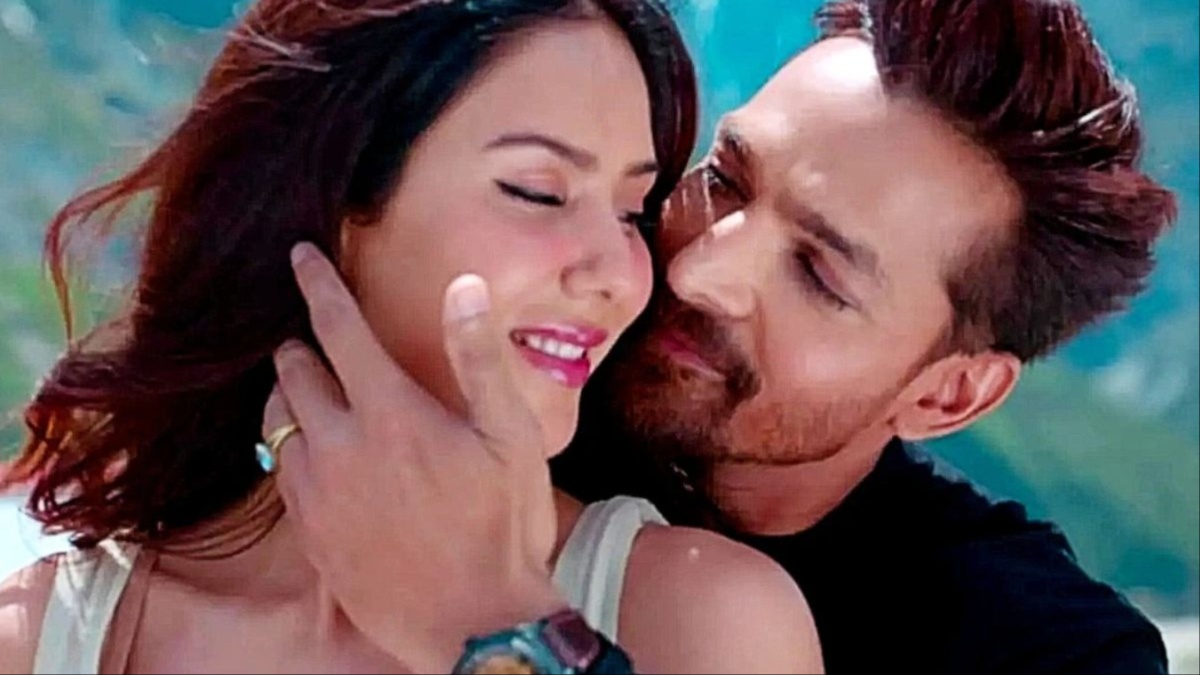
The story revolves around Vikramaditya Bhosle (Harshvardhan Rane), a golden-hearted political heir with access to power, money, and muscle. He is introduced as a man of contradictions: benevolent to the poor, ruthless to his enemies, and endlessly convinced of his own moral superiority. When he falls in love with Adaa Randhawa (Sonam Bajwa), a superstar actress, his affection rapidly mutates into a form of sociopathy that the film insists on framing as “pure” devotion.
To establish Vikram’s saintliness, we see him promising to take care of a young street vendor—only for the child to return immediately to selling peanuts, forgotten by Vikram and his entourage alike. In another scene, Vikram threatens an industrialist at Bandra Fort with theatrical menace. These gestures are meant to complicate his character; instead, they underline how superficial the writing’s understanding of morality really is.
Consent as an Inconvenience, Not a Boundary
Adaa, to her credit, recognises Vikram almost immediately for what he is: a delusional man confusing access with affection. Their dynamic is set during an armed forces’ visit—because in the film’s worldview, patriotism is apparently an essential ingredient of romance. Vikram has already imagined a wedding, a married life, and a shared future with Adaa before she has even expressed interest.
Her rejection is clear. His response is not.
What follows is a textbook case of cinematic entitlement. Vikram refuses to accept her “no,” escalating his behaviour from intrusive to threatening with alarming ease. He targets her family, her career, her mental health, and even orchestrates political goons to disrupt the screening of her film under the guise of hurt religious sentiments. At no point does the narrative meaningfully condemn him. Instead, it frames his actions as misguided passion, while positioning Adaa’s resistance as cruelty.
The film tiptoes—no, frolics—into “No Means Yes” territory with the enthusiasm of a frisky labrador waiting to be adopted. It is deeply uncomfortable viewing, made worse by the film’s insistence that it is saying something profound about love and madness.
The Soundtrack as a Substitute for Storytelling
One of the most glaring weaknesses of Ek Deewane Ki Deewaniyat is its reliance on music to replace basic cinematic functions like dialogue, emotional development, and narrative progression. The Mohit Suri Lite soundtrack is omnipresent, swelling in moments that desperately need silence or introspection.
Instead of characters speaking to each other, songs speak for them. Instead of emotions being earned, they are announced via background score. By the time the film reaches its midpoint, it feels less like a drama and more like an extended montage of wounded masculinity set to melancholic tunes.
There is not a single striking frame, visual idea, or aesthetic choice that feels original. Every shot feels borrowed—from better films, better directors, and better eras.
The Interval Block: A Moment for the Ages (Unfortunately)
If Ek Deewane Ki Deewaniyat is remembered at all, it will likely be for its interval block—a sequence so audacious, so misguided, that it almost circles back to camp.
Driven to desperation by Vikram’s relentless torment, Adaa switches from pristine white outfits to femme-fatale red and storms his political rally. On live television, she announces that she will sleep with any man who kills Vikramaditya before Dussehra.
Yes, that actually happens.
The film presents this moment as Adaa’s “sanak”—her madness, her defiance, her reclamation of agency. In reality, it is a grotesque misunderstanding of female rage and autonomy. Rather than allowing Adaa a meaningful escape or resistance, the screenplay forces her to weaponise the very masculinity that is destroying her.
Naturally, Vikram does not get the message. Instead, he spirals into tone-deaf heartbreak: “You are prepared to sleep with a stranger but not me?” His pain becomes the emotional centre of the film, while her trauma is treated as an inconvenience.
Strip away the slow-motion entries, the unimpressed glances, and the dramatic pauses, and the film would lose nearly two hours of runtime.
Fetishising Penance, Punishing Women
The film insists that Vikram is a broken monster, scarred by childhood trauma—specifically, the belief that he “killed” his mother during childbirth. While this backstory is meant to humanise him, the filmmaking cannot resist fetishising his suffering. His self-punishment is framed as noble. His willingness to die for Adaa is presented as the ultimate proof of love.
Adaa, meanwhile, is increasingly portrayed as cold, heartless, and unreasonable for refusing to be moved by his penance. The audience is subtly encouraged to grow impatient with her anger, her fear, her refusal to forgive.
At one point, she scatters his photographs around an empty funeral pyre, expressing a disturbing fascination with his potential death. The film seems aroused by this idea—unable to decide whether it condemns or celebrates the emotional violence unfolding onscreen.
It is bizarre, unsettling, and unintentionally revealing of the screenplay’s unresolved kinks.
Performances Trapped in a Bad Idea
Harshvardhan Rane is clearly attempting to capitalise on the re-release success of Sanam Teri Kasam, leaning into the image of the self-destructive alpha male with a wounded soul. There is something compelling about Rane as a screen presence—but not here. His Vikramaditya is less a character and more a symptom of Bollywood’s long-standing confusion between pain and romance.
Sonam Bajwa is done no favours by the writing. Reduced to displeased poses, ramp walks, and icy stares, Adaa becomes a woman whose hatred is gradually reframed as covert love. She is wooed under the pretext of being terrorised, and the film expects us to find poetry in that progression.
Veteran actors like Sachin Khedekar and Anant Mahadevan appear almost stranded, lending gravitas to a narrative that refuses to grow up.
A Genre That Deserves Better
Watching Ek Deewane Ki Deewaniyat inadvertently highlights how delicately other films have navigated similar terrain. Haseen Dillruba, Rockstar, Saiyaara, and Manmarziyaan are all flawed and divisive in their own ways, but they attempt—however imperfectly—to interrogate obsession rather than glorify it.
Milap Milan Zaveri’s film, on the other hand, seems uninterested in introspection. It gestures towards critique but cannot resist indulging the very ideas it pretends to question.
Final Verdict
Ek Deewane Ki Deewaniyat is technically a love story, emotionally a horror film, and ideologically a cautionary tale gone wrong. Haunted by mediocrity, misogyny, massy excuses, and phantom wokeness, it stands as an example of what happens when filmmakers mistake obsession for depth and suffering for sincerity.
In a parallel universe, this film might have inspired a generation of young men to romanticise stalking, entitlement, and emotional violence in the name of “pure” love. In this universe, thankfully, it is more likely to inspire nothing more than a splitting headache.
And that, strangely enough, is the best-case scenario.