
MLWBD Movie Reviews – Wake Up Dead Man: A Knives Out Mystery Review
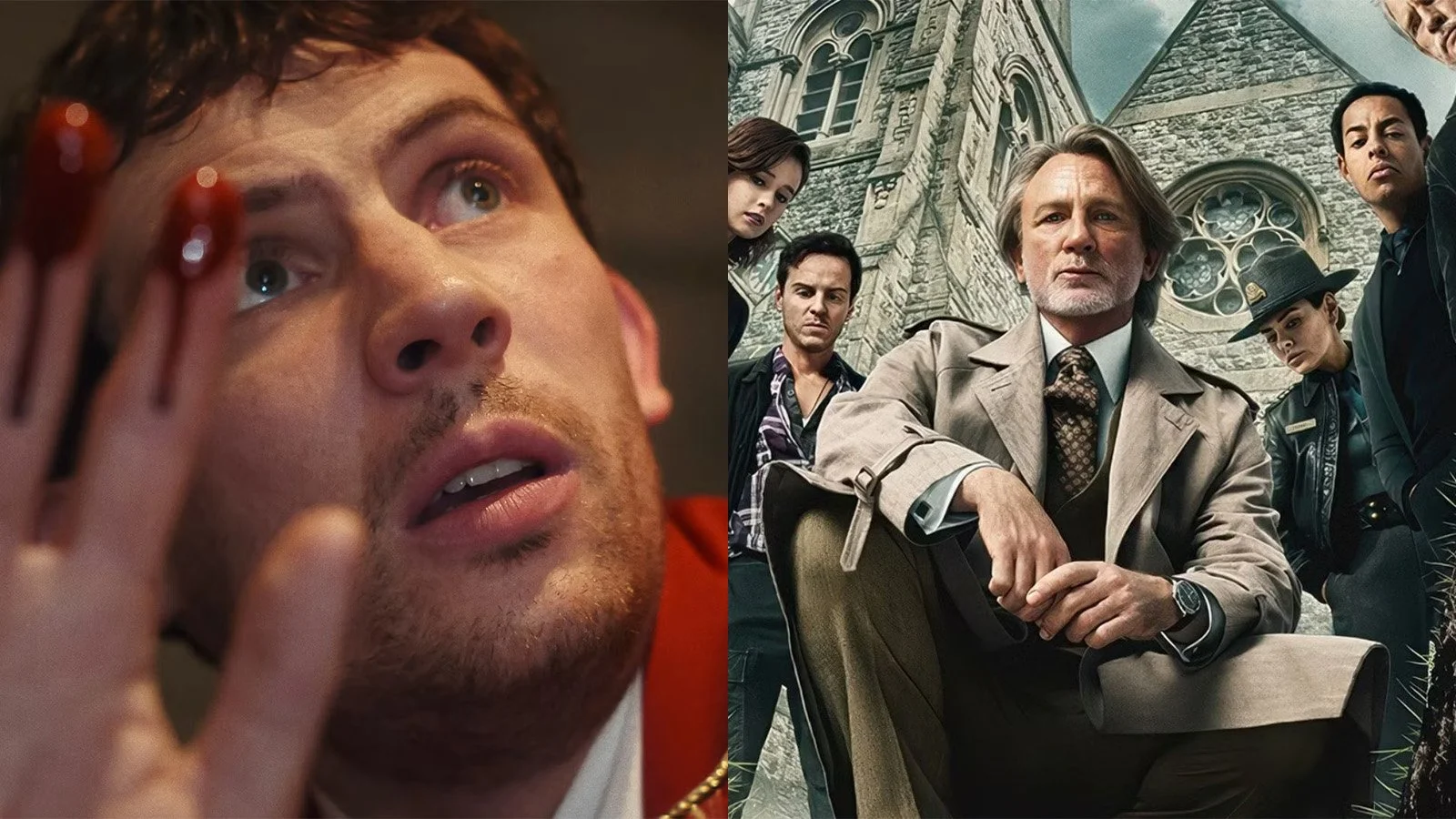
A Chilling, Gothic, And Razor-Sharp Third Triumph For Benoit Blanc
Across more than a century of detective fiction, a select few sleuths have transcended their stories to become cultural icons. Hercule Poirot, Sherlock Holmes, Miss Marple, and Nero Wolfe each belong to that rarefied pantheon. And now, with Wake Up Dead Man: A Knives Out Mystery, filmmaker Rian Johnson makes a compelling argument that Benoit Blanc—Daniel Craig’s honey-voiced, theatrically mannered “observer of the truth”—belongs in their company. With this third entry, Johnson’s modern whodunnit series forms one of the most consistent and creatively daring trilogies of the 21st century: each film distinct in atmosphere, yet unified by sharp wit, cunning construction, social commentary, and Craig’s exuberant performance.
If Knives Out was a crisp autumnal tale of old money decay, and Glass Onion a sunlit summer satire of tech-bro delusion, then Wake Up Dead Man arrives like a cold winter gust. It is gothic, morbid, and steeped in shadows—both literal and metaphorical. The setting, the small upstate New York town of Chimney Rock, adds a bracing chill to the film’s meditations on faith, belief, guilt, and spiritual longing. Johnson’s title card alone—rendered in a funereal gothic typeface—announces a darker, stranger film. Yet the signature humour remains intact, threaded through the film like a nerve that twitches beneath the solemnity.
In this mlwbd movie reviews feature, we take a deep dive into how Wake Up Dead Man delivers its smartest, bleakest, and perhaps most morally provocative mystery yet.
A Priest, A Murder, and an Impossible Crime
The premise is delightfully classical: a priest lies dead under circumstances so impossible that they verge on the supernatural. And only one man can unravel the knot.
Josh O’Connor’s Father Jud Duplenticy—described by himself, almost guilelessly, as “young, dumb, and full of Christ”—has recently arrived in Chimney Rock to serve alongside the older, more entrenched Monsignor Jefferson Wicks (Josh Brolin). Wicks, a fire-and-brimstone conservative-celebrity preacher beloved by some loyal parishioners and feared by others, is soon discovered dead in a manner that defies logic, physics, and common sense. It is a locked-room mystery so perplexing that references to John Dickson Carr’s The Hollow Man (the genre’s classic “impossible murder” handbook) appear throughout.
Enter Benoit Blanc.
Craig strolls into the narrative unusually late, not dominating the first act but appearing in the second like a clarifying breeze. With winter-coat collars upturned, drawling vowels cascading like warm syrup, and a detective’s eye sharper than a sacramental blade, Blanc is summoned to decode the impossible. And as always, Blanc does not simply solve the crime—he dissects the culture, psychology, and small-town tensions that birthed it.
Rian Johnson’s Human Puzzle Box
Johnson’s writing is—and remains—the beating heart of this franchise. Where Glass Onion thrived on dizzying structural reversals and a cynical critique of billionaire stupidity, Wake Up Dead Man is methodical and meditative. The structure here is less flashy but more emotionally grounded, more morally entangled. It is a film concerned with guilt, sin, resentment, and the ways faith can heal or corrupt.
The first act introduces an ensemble cast worthy of a Sunday sermon delivered by a playwright:
- Glenn Close as a zealous parish traditionalist
- Kerry Washington as a harried lawyer and reluctant community mediator
- Andrew Scott as a writer broken by failure
- Cailee Spaeny as a gifted cellist restricted by disability and bitterness
- Daryl McCormack as an oily local political hopeful
- Jeremy Renner as the perpetually pickled town doctor
Each member is given resentments, secrets, sins—and each is potential motive material. And yet, as grand and talented as the cast is, they ultimately orbit one figure:
Father Jud, portrayed by O’Connor with a balancing act so delicate it borders on miraculous.
O’Connor carries the film with gentleness, youthful insecurity, intermittent rage, and unexpected humour. Through confession scenes—some tragic, some darkly comedic—we meet Chimney Rock’s sinners, and slowly the mystery takes shape. Johnson cleverly uses these confessional encounters not only to deposit clues, but to expose Jud’s own emotional wounds.
There is one scene late in the first act—played initially for laughs—that slowly pivots into a devastating portrait of spiritual responsibility. O’Connor handles this tonal whiplash with such raw sincerity that it becomes one of the trilogy’s best moments.
Faith, Heresy, and the American Soul
Johnson, himself a former churchgoer, approaches religion with a curious blend of respect, scepticism, and wry observation. His film examines:
- American Christianity twisted into political weaponry
- Chronic guilt disguised as piety
- The struggle between compassion and doctrinal rigidity
- How belief becomes an anchor or a burden
He threads Catholic sacraments—confession, reconciliation, blessing—into the narrative with both reverence and humour. The film’s depiction of faith is far more nuanced than the genre typically allows. Much like Paul Verhoeven’s Benedetta, it is a work that takes theology seriously even as it playfully prods its contradictions.
Blanc, meanwhile, remains a rational “proud heretic.” He respects the faithful, but he follows logic wherever it leads. His arc—subtle, humane, and arguably his most personal yet—has him learning something about grace without ever sacrificing his secular grounding.
Craig is magnificent. His southern drawl is thicker than ever, his word-choices more florid (“perfidious bubbles of belief” may be his greatest verbal creation yet), and his screen presence irresistibly dapper. He is now one of cinema’s great comfort-characters, a detective who makes the audience feel somehow brighter merely by speaking.
The Ensemble: Brilliant, But Underused
One criticism leveled by many is the under-utilisation of the star-studded cast. With so many A-listers on hand, you would expect each to get a showcase moment. They do not. For some, their roles amount to little more than elevated cameos. Glenn Close is memorable but fleeting. Kerry Washington is excellent but underexplored. Renner’s appearance is funny but brief (and notably unconnected to the hot sauce running gag from Glass Onion).
Yet this does not feel like a flaw so much as a deliberate aesthetic. Johnson structures Wake Up Dead Man not as an ensemble piece, but as a character study of Jud and Blanc, with everyone else providing texture and context.
Fans may want more screen time for particular favourites, but narratively, the distribution serves the central emotional arc effectively.
A Mystery Rooted in Tradition, But Never Predictable
Johnson loves detective fiction, and this film might be his purest homage yet. For the first time, Blanc openly acknowledges Agatha Christie by name. The script directly references locked-room mystery conventions, and Johnson plays fair with the audience: the clues are all there, laid neatly, cleverly, and even cheekily before our eyes.
While the plot does not employ the bravura mid-film structural reversal of Glass Onion, it remains impressively intricate. Johnson’s ability to twirl narrative threads until they form a satisfying knot—and then unravel them with panache—is fully on display. The final reveal is not as shocking as in the first two films, but it is arguably more emotionally potent. It feels organic, inevitable, tragic, and painfully human.
This is a whodunnit that earns its genre status not through trickery, but through psychological honesty.
Cultural Commentary Beneath the Snow
Each Knives Out film picks apart some facet of contemporary America:
- Knives Out: inherited wealth and entitlement
- Glass Onion: billionaire incompetence and tech narcissism
- Wake Up Dead Man: religious extremism, culture-war politics, moral absolutism
Johnson skewers but never sneers. He captures both the repugnant and the beautiful in American Christianity. The hypocrisy and the hope. The manipulation and the meaning. The film is sharper than its predecessors in political critique, but also more tender. The balance is delicate, and Johnson pulls it off with surprising grace.
He also has not lost his humour. The film is frequently laugh-out-loud funny, with jokes woven so subtly into dialogue that they feel like private gifts to attentive viewers. Blanc’s comments about his own atheism are delivered with disarming charm. Moments of absurdity interrupt solemn scenes in ways that feel authentically human, not tonally jarring.
Visuals and Atmosphere: A Wintry, Gothic Mood Piece
Cinematically, this is the most atmospheric of the trilogy. The snowy small-town setting is beautifully captured: stark, silent woods; lonely church interiors; flickering candlelight reflected in sorrowful eyes. The cinematography embraces muted blues, frosty whites, and ember-warm yellows in confessionals.
It is a film that looks cold, feels cold, and uses that coldness to deepen its themes.
Johnson’s favourite visual trick—the slow push-in on a character’s face as a confession or revelation lands—returns in abundance. The score, by Nathan Johnson, is haunting and ecclesiastical, with choir-like motifs that twist into ominous dissonance. The entire film feels like an elegy: for faith, for innocence, for community, for truth.
A Worthy Addition to Detective Canon
With Wake Up Dead Man, Rian Johnson solidifies himself as one of the best modern mystery craftsmen. His Benoit Blanc films are not mere genre exercises—they are cinematic novels, rich with personality, thematic depth, humour, and artistry. This third entry is perhaps his most mature, most literary, and most emotionally layered.
Blanc may only be on his third story, but these films already stand tall beside Christie’s Poirot adaptations and Hitchcock’s lighter mysteries. Johnson clearly intends to continue. In interviews, he has mentioned wanting to make Blanc mysteries for as long as Craig will perform the role. After Wake Up Dead Man, that promise feels not only feasible but essential.
The film ends not with a tease for a sequel, but with a sense of possibility. A recognition that Benoit Blanc’s work is never done. The world will always produce crimes worth solving—and people worth understanding.
Final Verdict
Gothic, iconoclastic, richly atmospheric, and wonderfully witty, Wake Up Dead Man: A Knives Out Mystery is a triumph.
Johnson delivers another immaculately plotted, thematically resonant whodunnit anchored by O’Connor’s soulful performance and Craig’s magnetic charm.
This is a detective story bold enough to wrestle with faith, modern America, and the impossible murder at its centre—all while delivering sly humour and delectable genre pleasures.
Rating: ★★★★★ (5/5)
A brilliantly crafted winter mystery and one of the finest entries in modern detective cinema.