
‘28 Years Later: The Bone Temple’ Review: Ralph Fiennes and Jack O’Connell Go Full Metal Freakout in Nia DaCosta’s Brutal, Bonkers Sequel
There is a particular kind of audacity required to make a fourth film in a horror franchise that many cinephiles still associate with the stripped-down, nerve-shredding purity of 28 Days Later. Even bolder is the decision to steer that franchise somewhere unexpected—away from the relentless immediacy of rage-infected terror and toward something stranger, more philosophical, and intermittently unhinged. 28 Years Later: The Bone Temple, directed by Nia DaCosta and written by Alex Garland, is not a sequel content to merely extend the mythology. It mutates it.
The result is a film that is frequently incoherent, often excessive, sometimes deeply moving, and never dull. It is a sequel that risks alienation in pursuit of obsession, swapping the raw panic of survival horror for a feverish meditation on faith, art, cruelty, and compassion at the end of civilization. Whether it fully coheres as a continuation of the 28 saga is debatable. That it announces itself as one of the most distinctive studio horror films in years is not.
A World Long Abandoned
By the time The Bone Temple begins, the world has largely washed its hands of Britain. The Rage Virus, which once threatened global collapse, has been quarantined to the British Isles. Europe has moved on. England has been sealed off and left to rot—its countryside stained red, its cities hollowed into graveyards.
This geopolitical shrug is one of the film’s quietest but most devastating ideas. Civilization does not fall in a blaze of glory; it simply decides some places are no longer worth saving.
Into this abandoned landscape returns Spike (Alfie Williams), the self-exiled adolescent protagonist last seen in 28 Years Later. Having left the fragile safety of his childhood community and what remained of his family, Spike is now searching not just for survival, but for meaning—an undefined path toward adulthood in a world where moral frameworks have collapsed along with infrastructure.
Williams, who impressed in the previous film, deepens Spike into a more complex figure here. He is older, harder, but still visibly unsettled by violence. He is not a natural-born killer, nor is he naïve enough to pretend innocence will save him. That tension—between revulsion and adaptation—defines his arc.
Enter the Bone Temple
The film’s most indelible creation arrives in the form of Dr. Ian Kelson, portrayed with electrifying commitment by Ralph Fiennes. Kelson is a survivalist medic, a man of science who remained behind when others fled or died. Over the years, he has constructed a grotesque monument: a sprawling temple built from human skeletons, arranged with ritualistic precision.
This macabre structure is not merely a backdrop; it is Kelson’s manifesto. It is science turned into art, atheism flirting with mysticism, rationality collapsing into obsession. When Kelson bellows, “Pride moves inside me like maggots in the corpse of Christ!” he is not simply delivering one of the most jaw-dropping lines in recent horror cinema—he is declaring the film’s thesis.
Fiennes plays Kelson as sinewy and feral in appearance but unmistakably educated in voice and bearing. His isolation has stripped him of restraint, not intellect. He is a man who listens to Iron Maiden, Duran Duran, and Radiohead on vinyl spun by a hand-cranked generator, as though he prepared for the apocalypse by curating the perfect Desert Island Discs playlist.
It is a bravura performance that oscillates between terrifying, absurd, and oddly tender. Fiennes does not ask the audience to like Kelson, but he dares them to understand him.
Science, Compassion, and the Infected
Perhaps the most radical departure The Bone Temple makes from its predecessors lies in its treatment of the infected themselves. The word “zombie” is never used, as always, but here the Rage Virus is approached not just as a death sentence but as a condition—one that might still contain traces of humanity.
Kelson’s obsession centers on Samson, an Alpha specimen of the infected played once again by Chi Lewis-Parry, whose imposing physical presence has become iconic within the franchise. Samson is massive, terrifying, and seemingly unstoppable. Yet Kelson has learned to subdue him with morphine darts, creating moments of uneasy calm amid the carnage.
What follows is one of the film’s strangest and most affecting threads: a tentative, evolving relationship between man and monster. Kelson begins to wonder whether memories linger beneath the virus, whether language, recognition, or empathy might still exist within the infected mind. “Or do I just give you peace and respite?” he asks Samson softly, his voice breaking through years of brutal pragmatism.
DaCosta and Garland take a significant tonal risk here, occasionally playing these interactions with a touch of dark humor. Samson becomes, improbably, a kind of stoner companion—an unlikely buddy whose presence allows Kelson to imagine a cure rather than an execution.
This compassionate curiosity is new to the 28 series, and it is deeply unsettling in the best way. It forces the audience to confront a question the franchise has previously avoided: if the infected are still, in some way, people, what does survival demand of us morally?
The Satanists Take Center Stage
Just as The Bone Temple seems poised to become an introspective, character-driven evolution of the franchise, it violently swerves. The film’s second major narrative force arrives in the form of Sir Lord Jimmy Crystal, played with ferocious charisma by Jack O’Connell.
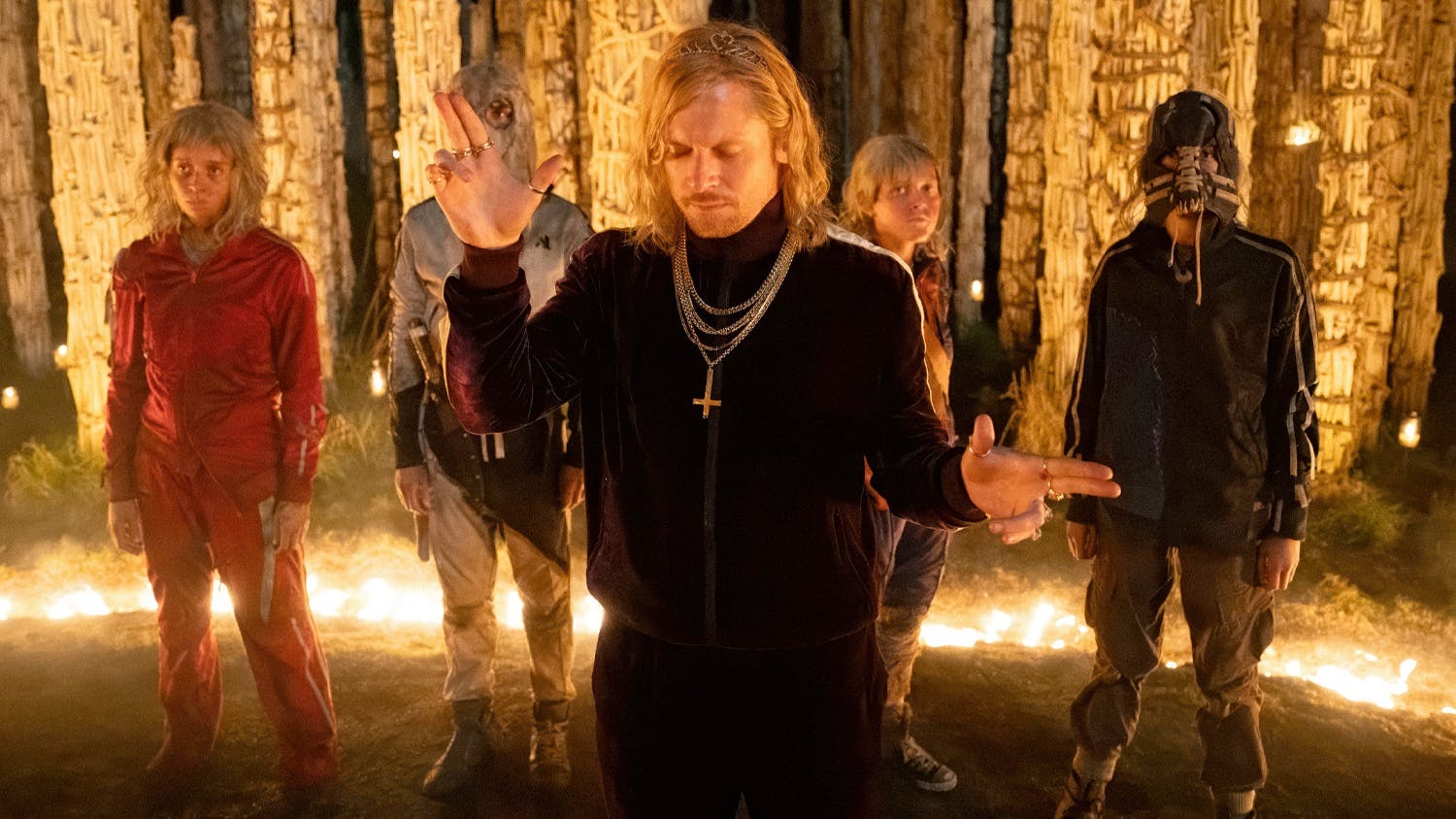
Jimmy is the leader of a roaming band of Satanists—though “cult” barely captures their aesthetic absurdity. He wears a tiara atop long blond hair, sports a bling-heavy tracksuit, and refers to his followers as his “fingers.” All are named Jimmy. All wear shaggy blond wigs reminiscent of Billie Eilish. It is ridiculous. It is terrifying. It is deliberately provocative.
O’Connell commits fully, delivering a performance that fuses messianic delusion with feral violence. Jimmy claims to serve “Old Nick,” a folkloric name for the devil, framing his brutality as divine charity. His group slaughters infected for sport, a choice that paradoxically diminishes the terror they once embodied while amplifying the cruelty of the uninfected.
Where earlier 28 films positioned the infected as the primary threat, The Bone Temple argues that humans, when untethered from morality, are far worse.
Torture as Theology
The Satanists’ version of “charity” involves the capture, mutilation, and ritualistic killing of uninfected survivors. These acts are framed as sacrament, turning pain into performance. It is here that the film flirts most dangerously with excess, veering into territory that can only be described as torture porn.
DaCosta does not shy away from the brutality, and while the violence is thematically justified, it tests the audience’s endurance. The film’s interest in spectacle—so carefully interrogated earlier through Kelson’s bone temple—threatens to consume itself.
Spike, accepted into the group after a savage initiation, becomes our moral anchor once again. He is repulsed by their cruelty, even as he recognizes the necessity of playing along. His ally within the cult is Jimmy Ink (Erin Kellyman), a young woman recruited in childhood who now sees through Sir Jimmy’s warped theology.
Kellyman brings quiet intelligence and weariness to the role, offering the film its clearest critique of blind devotion. When the group captures a farming family and begins flaying them alive, the film draws a hard line: survival without ethics is damnation by another name.
Coherence vs. Conviction
Does 28 Years Later: The Bone Temple function as a coherent extension of the world Danny Boyle and Alex Garland created in 2002? Not entirely. Its folk-horror detours, Satanic iconography, and philosophical digressions mark a significant tonal departure from the franchise’s origins.
But coherence is not the film’s primary goal. Conviction is.
DaCosta directs with fearless intensity, embracing whiplash as a stylistic choice rather than a flaw. The film leaps between horror, satire, tragedy, and near-comedy with reckless confidence. Some transitions are smoother than others, but the energy never flags.
Garland’s script is dense with ideas—too many, perhaps—but they are ideas worth wrestling with. Faith versus reason. Art versus survival. Mercy versus extinction. These are not subtle themes, but the film earns its lack of subtlety through commitment.
Performances That Carry the Madness
If The Bone Temple ultimately works more often than it should, credit belongs largely to its cast. Fiennes is extraordinary, delivering one of the most unhinged and compelling performances of his career. He anchors the film’s philosophical ambitions with raw humanity.
O’Connell, meanwhile, proves once again that he excels at characters who weaponize charisma. His Sir Jimmy is seductive, repellent, and disturbingly plausible—a cult leader who thrives on spectacle and devotion.
Alfie Williams continues to impress as Spike, grounding the film’s excess with emotional authenticity. And Chi Lewis-Parry’s physical performance as Samson remains a haunting embodiment of the franchise’s origins, even as his role evolves into something unexpectedly poignant.
Final Verdict: A Beautiful, Brutal Mutation
28 Years Later: The Bone Temple is not a comfortable sequel. It is messy, provocative, and at times overwhelming. But it is also fearless, imaginative, and strangely compassionate.
In choosing to explore the spiritual and philosophical fallout of apocalypse rather than simply escalating its body count, the film redefines what a long-running horror franchise can attempt. It may not please everyone, and it certainly will not satisfy purists longing for the raw simplicity of 28 Days Later.
But as an act of cinematic mutation—a bold reinvention rather than a safe continuation—The Bone Temple stands as a fascinating, ferocious achievement. Whiplash-inducing, yes. But in a genre that too often confuses repetition with reverence, it is a risk worth taking.